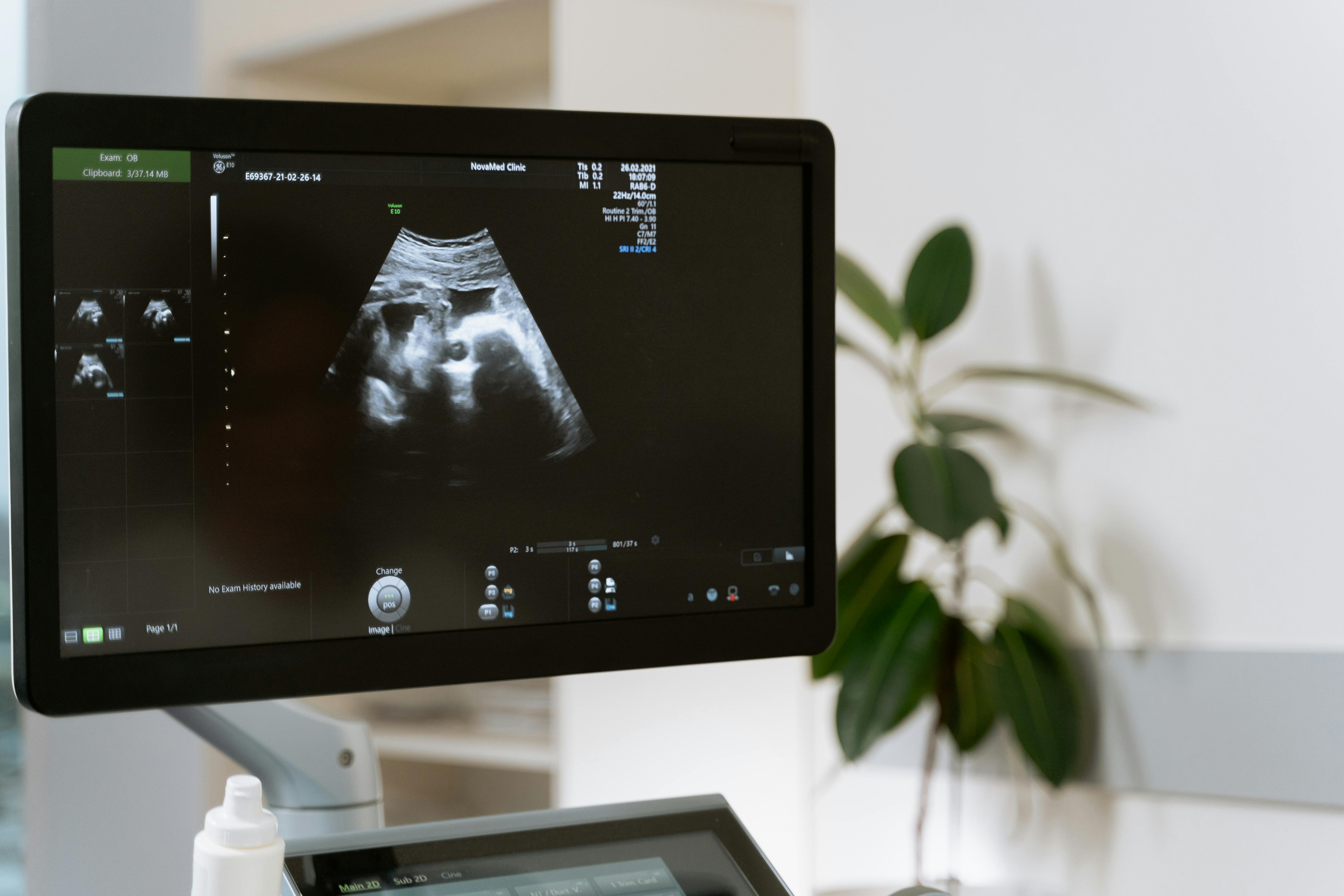
What is a gynaecological ultrasound?
A gynaecological ultrasound is an imaging scan that uses sound waves to produce real-time pictures of the uterus, ovaries, fallopian tubes, and surrounding pelvic structures. It is the first-line investigation for most gynaecological symptoms and is used to identify conditions including fibroids, ovarian cysts, polyps, endometriosis, and abnormalities of the womb lining. The scan is painless, takes 10-15 minutes, and involves no radiation.
At our clinic, ultrasound is performed by a Consultant Gynaecologist rather than a technician. This means the person interpreting the images is the same person who is managing your clinical care, so findings can be discussed with you immediately and next steps agreed in the same appointment.
Types of scan we offer
Transvaginal ultrasound
A small probe is gently inserted into the vagina to produce high-resolution images of the uterus, ovaries, and cervix. Transvaginal scanning provides significantly clearer images than abdominal scanning because the probe is closer to the structures being examined. It is the standard approach for most gynaecological investigations.
The probe is slim (about the width of a finger), covered with a protective sheath and gel. Most women find the scan comfortable. You may feel slight pressure but it should not be painful.
Abdominal ultrasound
The probe is moved across the lower abdomen with gel applied to the skin. A partially full bladder is needed to create a clear acoustic window. Abdominal scanning is used when transvaginal scanning is not possible or not appropriate (for example, in women who have not had penetrative sex), or alongside transvaginal scanning to assess larger structures.
Combined approach
For some investigations, both transvaginal and abdominal scanning are used in the same appointment to give the most complete picture.
What can a pelvic ultrasound detect?
A gynaecological ultrasound can identify:
- Ovarian cysts — size, type (simple fluid-filled, complex, dermoid, endometrioma), and whether monitoring or treatment is needed.
- Fibroids — number, size, location (submucosal, intramural, subserosal), and whether they are likely to be causing your symptoms.
- Endometriosis — endometriomas (chocolate cysts) on the ovaries and signs of deep infiltrating endometriosis affecting the bowel or bladder. Superficial endometriosis cannot be seen on ultrasound.
- Endometrial changes — thickening of the womb lining (relevant for postmenopausal bleeding, irregular periods, or suspected endometrial polyps).
- PCOS — polycystic-appearing ovaries (multiple small follicles visible on the ovary surface). Ultrasound is one of the three diagnostic criteria for polycystic ovary syndrome.
- Adenomyosis — a condition where the womb lining grows into the muscular wall of the uterus, causing heavy periods and pain.
- Coil position — confirming that an IUD or IUS is correctly placed. Recommended 6-8 weeks after fitting.
- Early pregnancy — confirming a viable intrauterine pregnancy, dating the pregnancy, and ruling out ectopic pregnancy.
- Unexplained pelvic pain — identifying structural causes of pain, including cysts, fibroids, free fluid, or torsion.
- Recurrent miscarriage — assessing the uterine cavity for structural factors (septum, fibroids, polyps) that may contribute to pregnancy loss.
How much does a gynaecological ultrasound cost?
| Scan | Price |
|---|---|
| Transvaginal ultrasound | From £350 |
| Abdominal ultrasound | From £350 |
| Combined transvaginal + abdominal | From £350 |
| Post-coil-fitting check (6-8 weeks after fitting) | From £350 |
| Gender scan | £350 |
| Gender + wellness scan | £450 |
The price includes the scan and same-day discussion of results with Mr Naoum. If additional follow-up appointments, blood tests, or procedures are needed based on the findings, these are priced separately and discussed with you before proceeding.
On the NHS, a gynaecological ultrasound requires a GP referral and waiting times vary from 2-8 weeks depending on urgency and your local trust. At our clinic, scans are usually available within a few days, often on the same day as your initial consultation.
What happens during the scan
For a transvaginal ultrasound, you undress from the waist down and lie on the examination couch with your knees bent. Mr Naoum inserts the probe gently and moves it to visualise each structure in turn: the uterus, the endometrium (womb lining), each ovary, and the surrounding pelvic area. The images appear on a screen in real time.
For an abdominal scan, you keep your clothes on (lifted above the abdomen) and lie on your back. Gel is applied to the lower abdomen and the probe is moved across the skin.
The scan takes 10-15 minutes. Mr Naoum will explain what he sees as the scan progresses and discuss the findings with you immediately afterwards.
If you would prefer a female chaperone to be present during the scan, let the clinic know when you book.
When should you have a gynaecological ultrasound?
An ultrasound is appropriate if you have:
- Heavy periods or periods that have changed.
- Bleeding between periods or after sex.
- Any bleeding after menopause.
- Pelvic pain (one-sided, central, or during sex).
- A suspected or known ovarian cyst.
- A suspected or known fibroid.
- Difficulty conceiving (assessment of ovaries, uterine cavity, and endometrium).
- A newly fitted coil that needs a position check.
- Abnormal findings on a smear test or pelvic examination that need further assessment.
If you are unsure whether an ultrasound is the right investigation for your symptoms, Mr Naoum can advise at a consultation (£250) and perform the scan in the same appointment if appropriate.
Ultrasound and other investigations
An ultrasound is often the starting point, not the end point, of investigation. Depending on what the scan shows, next steps may include:
- Blood tests (CA-125 for ovarian markers, hormone panel for PCOS, thyroid function).
- A smear test if cervical assessment is needed.
- A colposcopy if cervical changes are seen.
- A hysteroscopy if the womb lining needs direct visualisation or biopsy.
- MRI for more detailed imaging of complex fibroids or deep endometriosis.
Mr Naoum can arrange all of these and will explain what is needed and why before proceeding.
Frequently asked questions
Book your ultrasound
Call 020 7183 1049 or book online. Same-day scans are often available. No GP referral needed. If you are coming for a consultation and think you may need a scan, let us know when you book and we can schedule both together.
Ground Floor, 117A Harley Street, Marylebone, London W1G 6AT
Book online